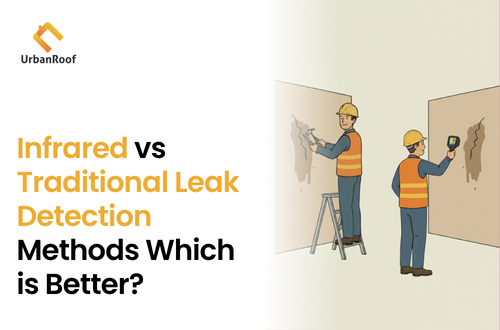
Infrared vs Traditional Leak Detection Methods: Which Is Better?
Finding Roof Leaks the Smart Way — Without the Guesswork
Roof leaks can be deceptive — water travels before it shows up as a visible stain.
By the time you notice a damp patch on your ceiling, the damage underneath may already be severe.
That’s where the method of leak detection makes all the difference.
At UrbanRoof, after inspecting thousands of Indian homes, we’ve seen how choosing the right leak detection method — Infrared Thermal Scanning or Traditional Visual Inspection — determines how fast and accurately leaks can be detected.
So, let’s compare both methods and find out: which one is really better for your roof?
Why Leak Detection Matters Before Waterproofing
Waterproofing is only as strong as the surface it protects.
If underlying moisture, cracks, or seepage aren’t identified first, even the best waterproof coating won’t last.
A professional leak detection process helps to:
- Pinpoint the exact leak source — not just visible stains
- Prevent unnecessary breaking or repair work
- Identify hidden moisture pockets within concrete
- Ensure the right waterproofing system is applied
Without proper detection, waterproofing often becomes a temporary fix instead of a long-term solution.
Traditional Leak Detection Methods
Before advanced tools, roof inspections depended mainly on visual assessment and manual testing.
While these methods are still common, they come with certain limitations.
1. Visual Inspection
Inspectors walk the roof surface to check for:
- Visible cracks or open joints
- Damaged or missing tiles
- Ponding or stagnant water
- Cracked sealants or flashing gaps
Pros: Simple, inexpensive, and immediate.
Cons: Cannot detect hidden leaks or trapped moisture under layers.
2. Water Flood Test
The roof surface is intentionally flooded for a few hours to observe if water seeps through.
Pros: Helps confirm major leakage zones.
Cons: Time-consuming, can damage weak roofs, and doesn’t identify internal moisture paths.
3. Electric Field Testing
Used on flat roofs with membranes — this test passes low-voltage current to find breaks or punctures.
Pros: Effective on membrane roofs.
Cons: Needs dry weather, complex setup, and trained operators.
Traditional methods rely heavily on surface observation, which often misses internal leaks invisible to the eye.
Infrared Leak Detection: The Modern Solution
Infrared (IR) leak detection uses thermal imaging cameras to detect temperature differences on the roof surface.
Since moisture holds heat differently than dry materials, infrared scans reveal hidden damp zones — even without removing tiles or membranes.
How It Works
- The roof is scanned using a thermal imaging device.
- Moisture-rich areas appear as warmer or cooler patches on the infrared screen.
- These patterns are analyzed to map the exact leak source and moisture spread.
Advantages of Infrared Detection
- Detects hidden leaks without dismantling the surface
- Covers large areas quickly
- Highly accurate and non-invasive
- Creates a visual moisture map for easy repair planning
- Helps verify effectiveness of waterproofing after work is done
UrbanRoof’s infrared inspection team uses high-precision thermal cameras to scan roofs for even the smallest moisture anomalies — long before damage becomes visible.
Infrared vs Traditional: Side-by-Side Comparison
| Factor | Traditional Leak Detection | Infrared Leak Detection |
|---|---|---|
| Accuracy | Depends on visible signs | Detects hidden moisture precisely |
| Time | Longer (manual inspection) | Faster (full roof scan in minutes) |
| Invasiveness | May require breaking | Completely non-destructive |
| Cost | Lower upfront | Higher, but more efficient long term |
| Coverage | Limited to visual area | Scans entire surface evenly |
| Ideal For | Small, visible leaks | Hidden or complex leak paths |
Verdict:
Infrared leak detection is far more accurate, faster, and preventive, especially for concrete and flat roofs.
Traditional inspection methods still have value for routine checks, but infrared technology offers the next level of precision and confidence.
How UrbanRoof Uses Infrared Leak Detection
At UrbanRoof, leak detection isn’t guesswork — it’s data-driven.
Our process combines thermal scanning, moisture meters, and expert assessment to create a full roof health report.
UrbanRoof Leak Detection Process:
- Visual Walkthrough – Identify visible cracks and weak zones.
- Thermal Imaging Scan – Detect hidden moisture pockets.
- Moisture Mapping – Document temperature variations.
- Data Analysis & Reporting – Generate detailed reports with images.
- Recommendation & Repair Plan – Suggest waterproofing or restoration methods based on findings.
This ensures that every repair or waterproofing project starts with accurate diagnosis, not assumptions.
When to Choose Infrared Leak Detection
You should consider a thermal scan if:
- You’ve had repeated leaks despite multiple repairs.
- You suspect internal dampness but can’t locate the source.
- You’re planning a new waterproofing system.
- You want to verify waterproofing after project completion.
Infrared scanning is especially valuable for:
- Flat roofs and industrial sheds
- Commercial complexes with large surfaces
- High-rise buildings where manual inspection is risky
Cost and Value of Infrared Leak Detection
While infrared testing costs more than traditional inspection, it saves thousands in unnecessary repairs and premature waterproofing failures.
Traditional repairs fix symptoms.
Infrared testing fixes the cause.
UrbanRoof’s infrared inspection packages are customized based on roof type, area, and accessibility — ensuring cost-effective accuracy.
UrbanRoof Insight
Most roofs that leak during the monsoon show no visible cracks from above — the issue lies beneath the surface.
Infrared leak detection helps identify these hidden damp layers, protecting your roof before problems become expensive.
The Bottom Line
When it comes to roof leak detection, accuracy and early detection matter most.
Infrared technology gives you both — without breaking a single tile.
At UrbanRoof, we use advanced thermal scanning tools alongside traditional methods to deliver a complete leak detection and waterproofing solution for Indian homes and businesses.
Think prevention, not repair — and your roof will thank you for years.